[ Decarbonization ]
The Approach >> Decarbonization 's Career Path >> MACF (CBAM)
Reducing Greenhouse Gas Emissions: The Benefits for Businesses
To combat global warming, European countries have adopted ambitious goals: to reduce greenhouse gas (GHG) emissions by at least 55% by 2030 and to achieve climate neutrality by 2050. For businesses and organizations, contributing to the achievement of these goals offers several benefits.
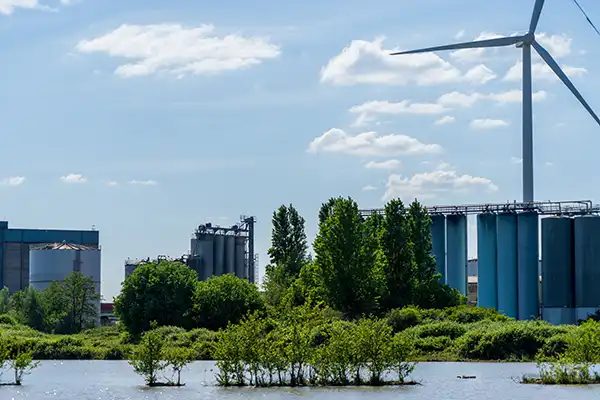


Why implement a " Decarbonization " approach?
Decarbonizing a company’s value chain is not just an environmental challenge—it is a key factor in competitiveness on many levels.
- Financial: Reducing reliance on fossil fuels and lowering energy consumption means being less dependent on energy costs—an aspect that is all the more strategic given the high volatility of costs that characterizes the energy markets.
- Regulatory compliance: Carbon footprint assessments are mandatory for all companies with more than 500employees.¹ In addition, certain companies are subject to carbon quotas (European Union Emissions Trading System (EU ETS)). Finally, companies that import goods from outside Europe must comply with the Carbon Border Adjustment Mechanism (CBAM).
- Resilience: Diversifying one’s energy mix is an asset in terms of energy independence, particularly by reducing reliance on fossil fuels, most of which are imported.
- Customers: Companies that can demonstrate the carbon performance of their products and services gain a competitive advantage.
- Investors: An increasing number of them are making their loans contingent on meeting an annual greenhouse gas emissions reduction target. The same is true for insurance companies, which have tightened their ESG criteria when calculating premiums.
- Employees: A company that takes steps to reduce its impact on the climate (and, more broadly, the environment) and incorporates these issues into its business model will find it much easier to recruit and retain its teams.
1 Carbon footprint assessments are also mandatory for local governments with more than 50,000 residents and public organizations employing more than 250 people.
What is the EU ETS?
The European Union Emissions Trading System (EU ETS) is the world’s largest greenhouse gas (GHG) emissions trading system.
Launched in 2005 to combat climate change, the program covers the energy and industrial sectors, supplemented by aviation, maritime transport, the service sector, and road transport (EU ETS 2).
Each year, companies in these sectors are assigned a GHG emissions cap, measured in metric tons ofCO2, that they must not exceed. If they do not reach this cap, they can sell their allowances to other covered entities through carbon markets: whether through auctions or over-the-counter trading, the EU ETS is based on this cap-and-trade mechanism.
To encourage participants to reduce their greenhouse gas emissions, the European Union is gradually lowering the permitted emission caps: this makes it more advantageous for companies to invest in their em Decarbonization s rather than purchase permits to emit beyond the cap (known as “EUAs,” or European Union Allowances).

Decarbonization: A 360° Approach
Decarbonization refers to the set of measures and techniques to be implemented to reduce carbon dioxide and other greenhouse gas emissions.
Since a company consists of multiple activities, the sources of these emissions are equally diverse: freight transport, employee and customer travel, energy consumption, purchases of goods, use of products throughout their lifecycle, end-of-life product disposal, waste, and more.
This is why a “ Decarbonization ” approach always requires the involvement of a wide range of business units, departments, and employees.
This is one of our unique strengths at Maliro : our projects often involve complex initiatives and/or those requiring a high degree of coordination. Our expertise in Decarbonization + energy + procurement enables us to manage projects that span these areas. For example, managing European emissions trading systems, the Carbon Border Adjustment Mechanism (CBAM), the Decarbonization of energy procurement, and grant applications are all topics that require this broad range of expertise.


Would you like to implement a Decarbonization strategy for all your business activities? Discover our 5-step support plan